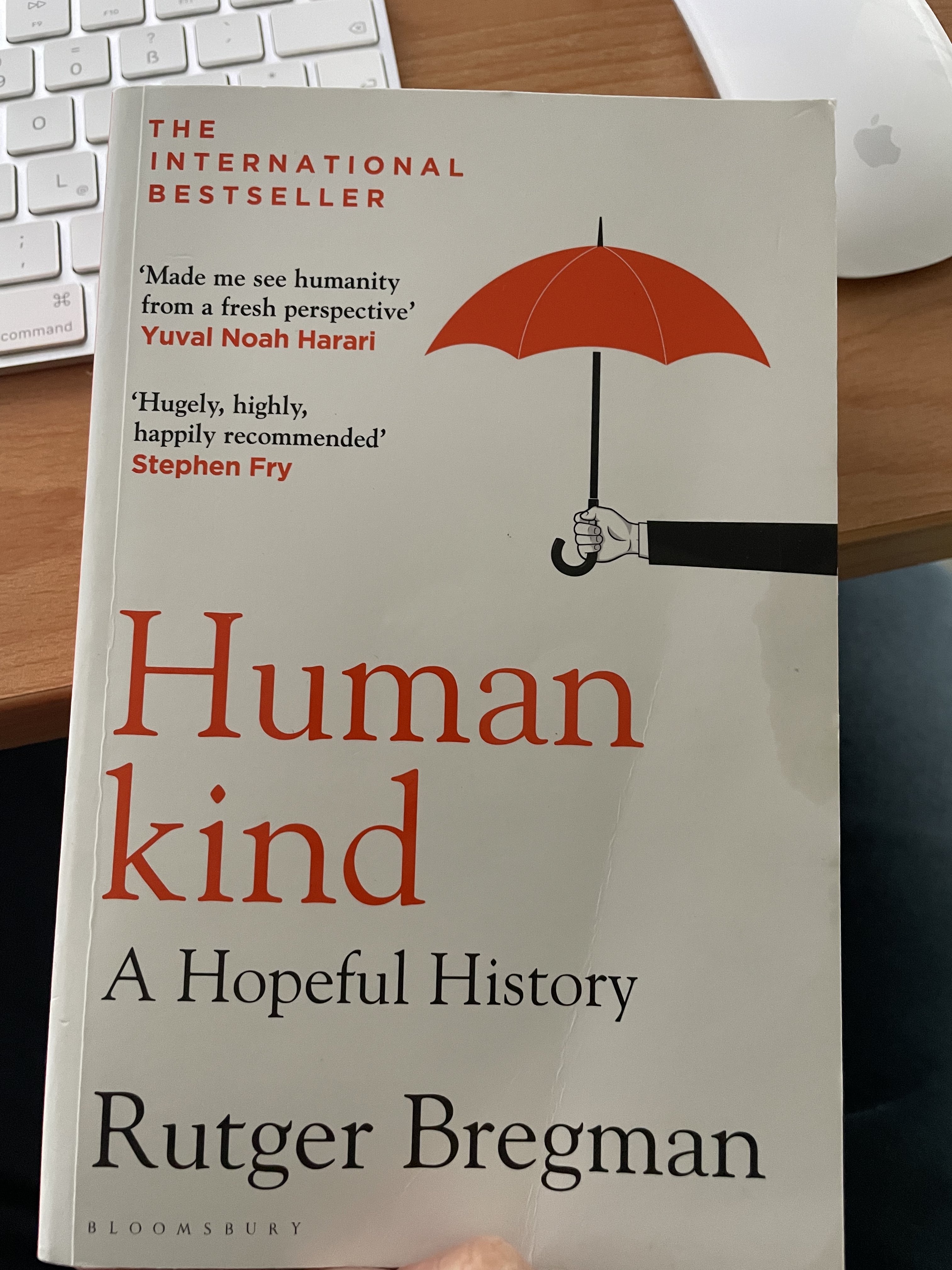
I acquired this book(Humankind: A Hopeful History - Rutger Bregman) during my Christmas vacation in the UK in 2023. While walking through the old town of Canterbury, we visited a Waterstones bookstore. During my time in the UK, Waterstones became my favorite spot whenever I had no plans; not necessarily because I’m a “true reader,” but because it was conveniently located near my apartment. (For my German friends, you can compare it to Thalia).The book sat on my shelf for nearly two years. To be honest, I am more of a greedy book buyer than a consistent reader :-). Finally, during the Christmas season of 2025, I picked it up.
My first impression was that the translation from Dutch to English used a very “British” style of English. As a non-native speaker, this was challenging, especially given the complex subject matter. The sophisticated vocabulary and “noble” words meant that, at first, I didn’t understand much. I had to keep Google Translate by my side, which slowed my reading speed significantly.However, I pushed through. After the first chapter, I became more familiar with the vocabulary and the author’s style. Language barriers aside, I truly liked the book and the author’s way of framing problems—starting with the Nazi “Blitz” campaign against England.
The core concept of Humankind is not necessarily new to Eastern philosophy. The system with the greatest influence on this idea is Confucianism. One notable figure is Mencius (VN: Mạnh Tử), who proposed the Theory of Innate Goodness (人之初,性本善) (these characters I copied from google :-) chinese characters are not my thing), suggesting that human nature is intrinsically good. In contrast, Xunzi (VN: Tôn Tử) argued that “human nature is evil.”. They both were student of Confusius. While these debates might feel foreign to Western culture, they are deeply ingrained in the cultures of China, Korea, Japan, and Vietnam. Even in Western philosophy, ancient thinkers like Aristotle and Adam Smith touched upon these themes. Why this book is special from my perspective, the book doesn’t just present a concept; it is praised for being well-researched, engaging, compelling, and optimistic. We live in a “media-era” filled with wrong narratives and media-driven thinking. With the dominance of social media and “instant-noodle” knowledge, people gradually start believing only what they want to believe. This reminded me of the book Factfulness (which I hope to review if I find the time).I also learned new concepts like the Golem effect, the Pygmalion effect, and pluralistic ignorance. They might sound like “dogmatic nerd stuff,” but if you want to know more, you should Google them—don’t be lazy! :-)
Ultimately, this book was well worth the time. After closing the cover, these sentences kept swirling in my head: “To be kind” and “All men are born with a good nature.”
 I captured this image since 200x, A volunteer old-lady boatman took children across the river to school during the flood season in south west of Vietnam.
— 27.01.2026 —
I captured this image since 200x, A volunteer old-lady boatman took children across the river to school during the flood season in south west of Vietnam.
— 27.01.2026 —